














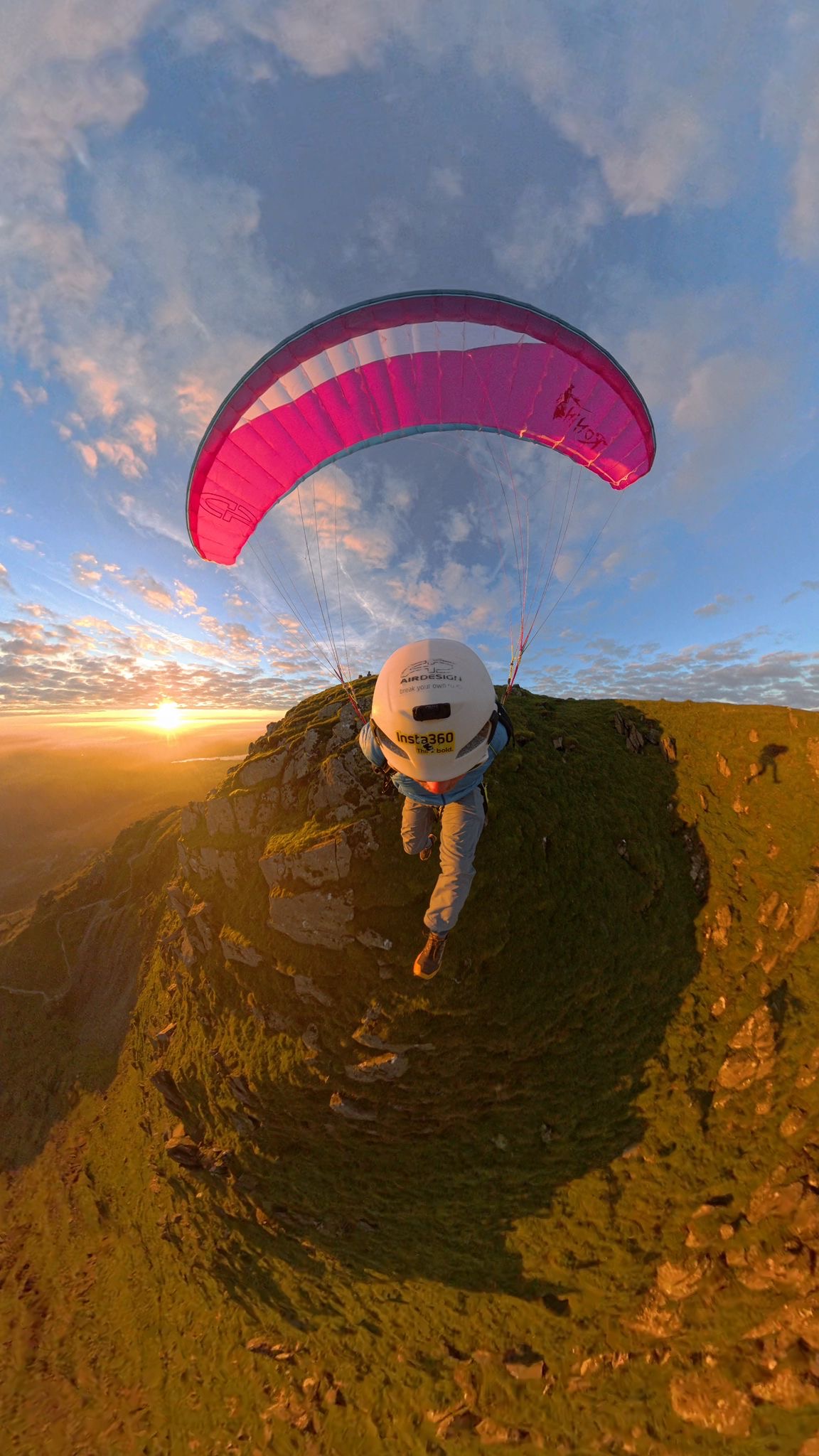


It’s worth mentioning that while I can fly fast with my wing, it’s not a bona fide speed wing, Its a parakite. In my opinion a parakite is the perfect tool for exploring the fellside terrain in the air. There is a pulley system in the risers that changes the whole aspect ratio of the wing when pulled or released so you can adjust your glide angle very easily.
When you pull the toggles the glide ratio is increased and you can fly over flatter terrain. If you let the toggles go right up to the pulleys the glider will dive steep and fast. This gives great options for proxy flying( close to terrain). It’s a hell of a lot of fun!

I think I choose my favourite Lakes lines (descent routes) on terrain features that are fun to explore or to fly down. There can be little challenges in them. Like positions that are difficult to get into, like Dungeon Ghyll or Crinkle Ghyll so we might session these lines trying to improve approaches and getting deep into the features.
Launches and wind angles are also important criteria. We have to launch into the wind so we have to have a good option for whichever direction the weather is coming from. Launches can be shallow and grassy (quite easy) or rocky and steep (sometime a bit trickier). The most fun is a cliff launch, where once the glider is inflated and overhead you can just run off the top of something steep.
1. Coniston Old Man: The Ultimate Speed Line
Coniston is by far my favourite line and my strava heat map demonstrates this quite laughably. This can be launched from south westerly round to north easterly.
The easterly aspects of the summit allow you launch straight into the bowl of Low water straight into steep terrain! So from the start you have to lose a lot of height fast in order to keep close to the fellside. Almost all of this line is old mine workings so there’s plenty to look at and plenty of features to weave in and out of.
There are several deep features that I try to get into and parts of the line follow the main path up so we often fly past walkers on their way about the hill. It’s alway nice to pop over the tarn and down Low Water beck too. There is so much to go at here that it feels like I never take the same route twice.
Highlights:
-
Dropping into the Low Water bowl
-
Diving through mine workings
-
Popping over Low Water Tarn
-
Running Low Water Beck
-
Endless lines, it genuinely feels different every flight
2. Harrison Stickle: A Playground of Ghylls and Crags
Harrison is great from westerly round south to easterly and can be launched on at NW at a push so gives a good range of wind angle options. The west side is a great cliff launch and drops straight into dungeon ghyll, the east side is a more gentle angle and leads over to Stickle Tarn and ghyll.
It’s always nice to hear some loud water so I enjoy getting close into the waterfalls on either side. The dungeon ghyll side is a much deeper feature so it’s a lot of fun to try and line up a set of turns that get you into the chasm in the lower section. It’s also pretty nice to fly past the climbers on Raven crag and Middlefell buttress losing some height fast and of course landing in the field outside the ODG!
Highlights:
-
Flying past climbers on Raven Crag and Middlefell Buttress
-
Steep vertical features and tight turns
-
Iconic landing in the field outside the ODG (Old Dungeon Ghyll Hotel)
3. Helvellyn: Long, Fast, and Perfect in a Westerly
A classic fell and as westerly wind is reliable, the west side of this hill gives reliable and absolutely fantastic parakite flying down to the fields at Swirls. The launch is from Lower Man at 925m so one of the longer speed flights to be had in the Lakes.
The high section leads past Browncove Crags holding a high glide ratio in order to make the distance. Once that height has been maintained you can drop into the lower slope with a bit of speed and the angle of the terrain here is fantastic for proxy.
The gentle drop off is difficult to stay close to so turns have to be made to lose height and keep low to the ground or into Helvellyn ghyll. This line can’t be flown on a speed wing as the horizontal distance from Lower Man is too great for the glide of these wings.
However a speed wing could launch from Browncove Crags and make the landing but I don’t think it’s as much fun as with the kite!
Highlights:
-
Long, sustained descent from Lower Man (925m)
-
Reliable westerly winds make it a consistent flying line
-
High glide required past Browncove Crags, leading into fast proxy terrain
-
Perfect parakite line with a smooth landing approach at Swirls
Why Parakiting in the Lake District Is So Special
Speed flying and parakite flying are really small and quite niche parts of the paragliding world. I believe it’s one of the greatest ways to explore mountain terrain. I tell people it’s like skiing but there’s no need for snow, just calm air!
Which is marginally more common. Training is essential and pilot ratings are critical in being responsible to other mountain users and for your own safety.